
[ACCÈS LIBRE] - Séance 26 - DEWA 2023
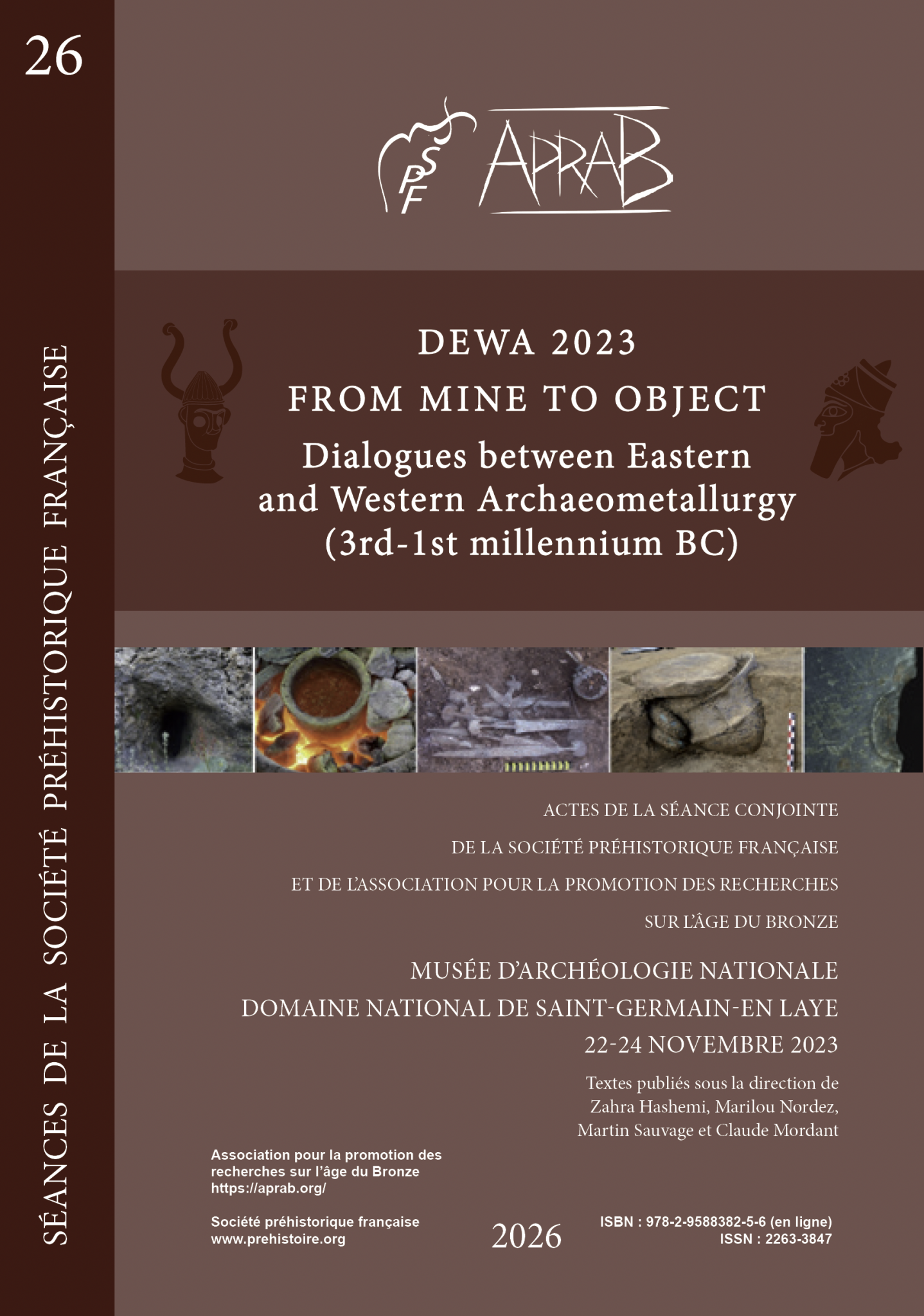
DEWA 2023
FROM MINE TO OBJECT
DIALOGUES BETWEEN EASTERN AND WESTERN ARCHAEOMETALLURGY
(3rd-1st MILLENNIUM BC)
Actes de la Séance conjointe de la Société préhistorique française
et de l’association pour la promotion des recherches sur l’âge du bronze
Saint-Germain-en laye, 22-24 novembre 2023
Textes publiés sous la direction de
Zahra Hashemi, Marilou Nordez, Martin Sauvage and Claude Mordant
(Séances de la Société préhistorique française, 26), 408 p.
www.prehistoire.org
ISSN : 2263-3847 – ISBN : 978-2-9588382-5-6 (en ligne)
Accès à la page des séances en accès libre
La Société préhistorique française permet le téléchargement gratuit de certaines de ses publications. Fidèle à ses traditions, la SPF veut ainsi être une fenêtre dynamique et accessible au plus grand nombre sur la recherche préhistorique en France et dans le monde.
Régie par la loi de 1901, sans but lucratif, la SPF vit des cotisations de ses adhérents.
Pour nous soutenir, n’hésitez pas à adhérer et à susciter de nouvelles adhésions autour de vous.
Pour suivre nos actualités et bien plus, abonnez-vous à la Newsletter de la SPF
Tous les fichiers sont en accès libre. Cliquez sur le titre de l'article pour le télécharger / All files are in open access. Click on the title of the paper to download it
Archaeometallurgy (of non-ferrous alloys) is a discipline which encompasses the entire field of ancient metallurgy, from the extraction of metals from their ores to the present state of archaeological objects, and has been rapidly expanding over the last two decades. Considerable progress in advancing the field is enhancing our knowledge, whether about ore extraction and mining activities, production processes (from ore to metal) or artefact transformation (from metal to finished product), as well as the lifecycle of metallic products (from finished products to their current status and location).
This structuring of archaeometallurgical research has been accompanied by several bulkheads: researchers are often specialists in one step of the chaîne opératoire, a type of approach, a category of scientific analysis, a specific material or a particular geographic area or time period. It makes for research compartmentalized between different approaches such as mining archaeology, archaeometry, technology and archaeology on one hand, and, for example, between Europe and the Near East on the other. Although interdisciplinarity, which is now the norm, relativize this observation, the various specialists often have difficulty gathering and exchanging ideas due to their disparate methods, training, research traditions and questions.
Otherwise, it seems that archaeometallurgical research is developing in parallel in Europe and in the Near East, with relatively few bridges between these two regions, although some researchers navigate between these very different chrono-cultural, technical, environmental, and socio-political contexts.
This is why, in the framework of this conference, we wanted to create a dialogue between these two worlds. Our objective was to provoke a disciplinary, methodological, geographical, and chronological decompartmentalization to bring together researchers who are rarely in contact despite the complementarity of their approaches. We hope, in the long run, that this approach will allow us to strengthen ties, weave collaborations, and create an interdisciplinary research group on archaeometallurgy in the entire Old World.
The conference was organized around four axes, making four main sessions:
1. Mining and ore extraction activities
2. Tools, actors and production loci: specialization and organization
3. The production process (chaînes opératoires), from metal to finished product
4. Exchanges and uses of metallic objects: from archaeological contexts to the laboratory
This conference was part of a series of meetings organised by the Société préhistorique française (SPF), in conjunction with the Association pour la promotion des recherches sur l’âge du Bronze (Aprab).
CONTENTS / SOMMAIRE
Claude Mordant and Martin Sauvage
Foreword vii
Marilou Nordez and Zahra Hashemi
Introduction: Between East and WestA state of the art ix
FIRST PART - Mining and ore extraction activities
Vincent Pigott and Vanessa Workman
If Southwest Asia is a Heartland of Metallurgy, where are the mines? 1
Thomas Stöllner
Romain Bussone, Franck Sumera, Olivier Lemercier and Pierre Camps
Prehistoric native copper production at Roua (Southern Alps, France) from the 4th millennium BC) 57
Ignacio Montero-Ruiz, Mercedes Murillo-Barroso, Aaron Lackinger and Daniel Pérez L’Huillier
SECOND PART - Tools, actors and production loci: specialisation and organisation
Francis Joannès
Economy and status of the metallurgist according to Babylonian texts of the 1st mill. BC 97
Muriel Mélin and Éric Néré
Caroline Hamon and Selina Delgado-Raack
and Bronze Age metal object production in Europe between the 3rd and 1st millennium BC 121
Anna Sörman
THIRD PART - The production process, from metal to finished objects
Barbara Armbruster
Omid Oudbashi
Mathias Haze, Benoît Mille and Christine Lorre
Léonard Dumont
Making Bronze Age Solid-hilted Swords: From chaînes opératoires to Craftspeople 243
FOURTH PART - Exchanges and uses of metal: from archaeological contexts to the laboratory
Zahra Hashemi
An Overview on Metal Artefact Deposits in Southwest Asia during the Iron Age 265
Alexis Gorgues, Thibault Picard, Thibaud Poigt, Nicolas Frèrebeau, Florent Comte, Marie Lefebvre, Marc Houzé, Ewen Ihuel and Raphael Gestreau
Life and Death of Middle Bronze Age axes. The case of the Medocan hoards 285
Kristina A. Franke, Zuzanna Wygnańska, Hélène David-Cuny, Mansour Boraik Radwan, Hassan Zein, Lloyd Weeks
Théo Enudde, Pierre-Yves Milcent and Benoît Mille
and Techno-Functional Study of the Axe Blades from Bourbonnais (France) 341
Cécile Le Carlier de Veslud and Sidonie Révillon
Isotopic and elemental analyses of north-western French Bronze Age metal hoards 383



Coordonnées
Pôle éditorial de la MSH Mondes
(Maison de l'archéologie et de l'éthnologie)
Boite 41
21 allée de l'Université
F-92023 Nanterre cedex - FRANCE