
[ACCÈS LIBRE] - Séance 25 - Lascaux_2021
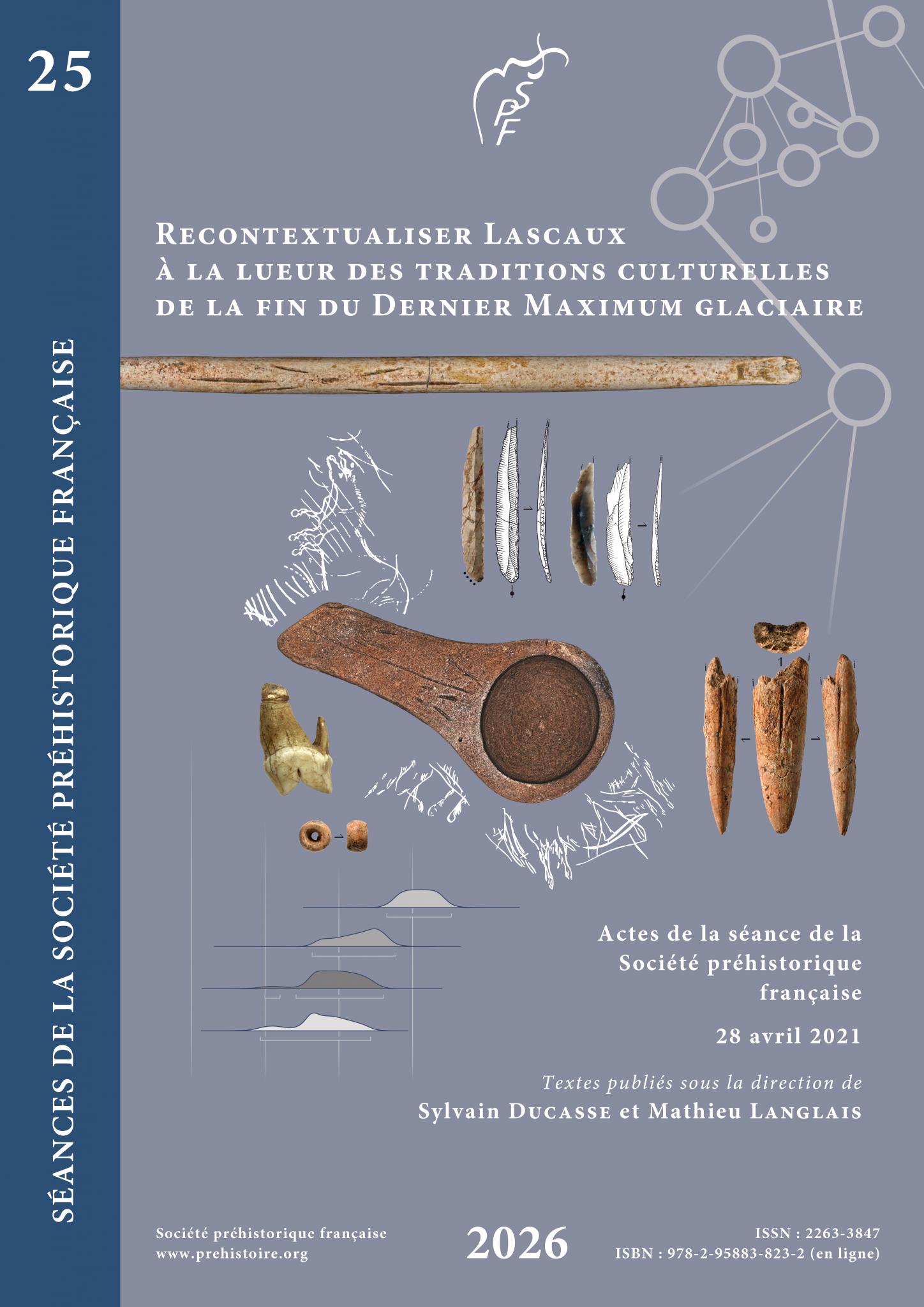
RECONTEXTUALISER LASCAUX
À LA LUEUR DES TRADITIONS CULTURELLES
DE LA FIN DU DERNIER MAXIMUM GLACIAIRE
Actes de la Séance de la Société préhistorique française
du 21 avril 2021
Textes publiés sous la direction de
Sylvain Ducasse et Mathieu Langlais
(Séances de la Société préhistorique française, 25), 367 p.
www.prehistoire.org
ISSN : 2263-3847 – ISBN : 978-2-9583-823-2 (en ligne)
Accès à la page des séances en accès libre
La Société préhistorique française permet le téléchargement gratuit de certaines de ses publications. Fidèle à ses traditions, la SPF veut ainsi être une fenêtre dynamique et accessible au plus grand nombre sur la recherche préhistorique en France et dans le monde.
Régie par la loi de 1901, sans but lucratif, la SPF vit des cotisations de ses adhérents.
Pour nous soutenir, n’hésitez pas à adhérer et à susciter de nouvelles adhésions autour de vous.
Pour suivre nos actualités et bien plus, abonnez-vous à la Newsletter de la SPF
Tous les fichiers sont en accès libre. Cliquez sur le titre de l'article pour le télécharger / All files are in open access. Click on the title of the paper to download it
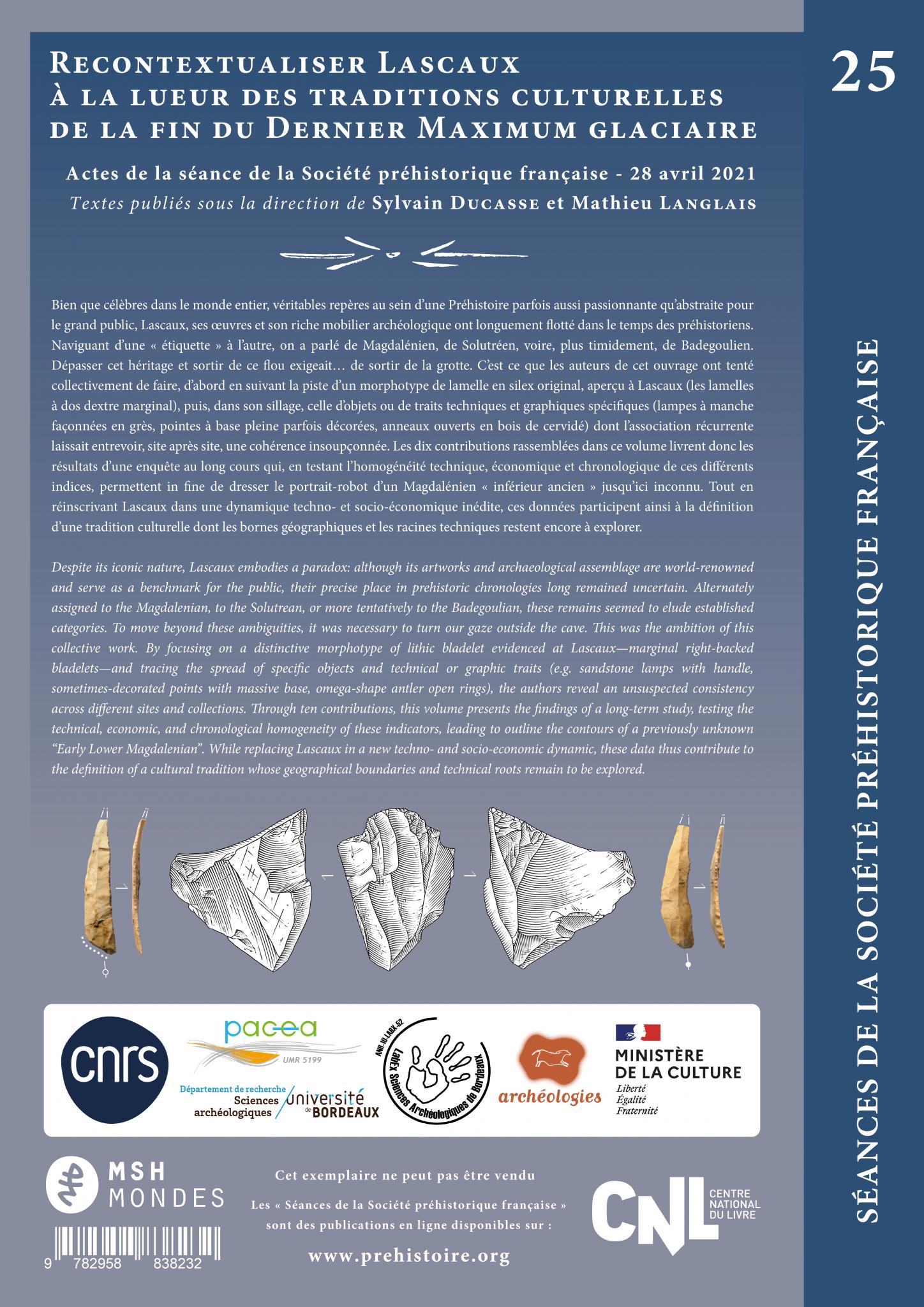
Bien que célèbres dans le monde entier, véritables repères au sein d’une Préhistoire parfois aussi passionnante qu’abstraite pour le grand public, Lascaux, ses œuvres et son riche mobilier archéologique ont longuement flotté dans le temps des préhistoriens. Naviguant d’une « étiquette » à l’autre, on a parlé de Magdalénien, de Solutréen, voire, plus timidement, de Badegoulien. Dépasser cet héritage et sortir de ce flou exigeait… de sortir de la grotte. C’est ce que les auteurs de cet ouvrage ont tenté collectivement de faire, d’abord en suivant la piste d’un morphotype de lamelle en silex original, aperçu à Lascaux (les lamelles à dos dextre marginal), puis, dans son sillage, celle d’objets ou de traits techniques et graphiques spécifiques (lampes à manche façonnées en grès, pointes à base pleine parfois décorées, anneaux ouverts en bois de cervidé) dont l’association récurrente laissait entrevoir, site après site, une cohérence insoupçonnée. Les dix contributions rassemblées dans ce volume livrent donc les résultats d’une enquête au long cours qui, en testant l’homogénéité technique, économique et chronologique de ces différents indices, permettent in fine de dresser le portrait-robot d’un Magdalénien « inférieur ancien » jusqu’ici inconnu. Tout en réinscrivant Lascaux dans une dynamique techno- et socio-économique inédite, ces données participent ainsi à la définition d’une tradition culturelle dont les bornes géographiques et les racines techniques restent encore à explorer.
Despite its iconic nature, Lascaux embodies a paradox: although its artworks and archaeological assemblage are world-renowned and serve as a benchmark for the public, their precise place in prehistoric chronologies long remained uncertain. Alternately assigned to the Magdalenian, to the Solutrean, or more tentatively to the Badegoulian, these remains seemed to elude established categories. To move beyond these ambiguities, it was necessary to turn our gaze outside the cave. This was the ambition of this collective work. By focusing on a distinctive morphotype of lithic bladelet evidenced at Lascaux—marginal right-backed bladelets—and tracing the spread of specific objects and technical or graphic traits (e.g. sandstone lamps with handle, sometimes-decorated points with massive base, omega-shape antler open rings), the authors reveal an unsuspected consistency across different sites and collections. Through ten contributions, this volume presents the findings of a long-term study, testing the technical, economic, and chronological homogeneity of these indicators, leading to outline the contours of a previously unknown "Early Lower Magdalenian". While replacing Lascaux in a new techno- and socio-economic dynamic, these data thus contribute to the definition of a cultural tradition whose geographical boundaries and technical roots remain to be explored.
SOMMAIRE / CONTENTS
Sylvain DUCASSE, Mathieu LANGLAIS
From a specific backed bladelet to the definition of a new technical tradition. Origin and outcomes of the DEX_TER project
Mathieu LANGLAIS, Sylvain DUCASSE, Laurent BROU, Jean-Christophe CASTEL, François-Xavier CHAUVIÈRE, Vincent DELVIGNE, François LACRAMPE-CUYAUBÈRE, Émilie LESVIGNES, Damien PESESSE, Jérôme PRIMAULT
An archaeostratigraphic synthesis between the Loire and the Pyrenees (22–19 cal. ka BP): What place for the “LDDM-yielding Magdalenian”?
Carolyn BARSHAY-SZMIDT, Philippe LANOS, Sylvain DUCASSE, Mathieu LANGLAIS, Laurent BROU, Stéphane MADELAINE, Jean-Baptiste MALLYE, Jean-Marc PÉTILLON, Jérôme PRIMAULT
Improving the chronological framework of LDDM-yielding Magdalenian assemblages of SW France: Reviewing the radiocarbon evidence and comparative Bayesian modelling with OxCal and ChronoModel
Mathieu LANGLAIS, Vincent DELVIGNE, Sylvain DUCASSE
Techno-economic structuring of blade and bladelet production in the Early Lower Magdalenian. Contribution of the comparative analysis of Combe-Cullier (Lacave, Lot, France) and Bouyssonie Cave (Brive-la-Gaillarde, Corrèze, France)
Jérémie JACQUIER, Mathieu LANGLAIS, Sylvain DUCASSE
Les lamelles à dos dextre marginal (LDDM), enquête techno-fonctionnelle sur un nouveau marqueur technique et chronologique 109
The marginal right-backed bladelets aka “lamelles à dos dextre marginal” (LDDM), a techno-functional study of a new technical and chronological marker
François-Xavier CHAUVIÈRE, María Isabel BORAO ÁLVAREZ, Claire HOUMARD, Caroline PESCHAUX, Jean-Marc PÉTILLON
Osseous industry and ornaments at the dawn of the Magdalenian (21.5–20.5 cal. ka BP)
Pascaline GAUSSEIN
Functional and/or symbolic spear points? The issue of incised projectile heads at the dawn of the Magdalenian: The example of level AG-IIIc of the Taillis des Coteaux (Antigny, Vienne)
Sylvain DUCASSE, Jean-Baptiste MALLYE, Jean-Marc PÉTILLON, Vincent DELVIGNE, François LACRAMPE-CUYAUBÈRE, Antony SÉCHER avec la collaboration de Salim KRENTNER
A missed opportunity? The Abri Houleau (Sainte-Florence, Gironde), a forgotten milestone in the recognition of the LDDM-yielding Magdalenian
Sylvain DUCASSE, François-Xavier CHAUVIÈRE, Jean-Marc PÉTILLON, Mathieu LANGLAIS, François LACRAMPE-CUYAUBÈRE
When “raclettes” meet LDDM: the origin of the Magdalenian culture, or a simple stratigraphic mixing?
Raphaël ANGEVIN, Vincent DELVIGNE, Sylvain DUCASSE, Mathieu LANGLAIS, Jacques VIRMONT, Jean-Paul RAYNAL
Possible Lower Magdalenian evidence in the Massif Central. The original microlithic components (LDDM and MLD) from Le Blot-Chantier 1 (Cerzat, Haute-Loire)
Vincent DELVIGNE, Sylvain DUCASSE, Mathieu LANGLAIS, Guilhem CONSTANS, Caroline PESCHAUX, Jérôme PRIMAULT, Marta SÁNCHEZ de la TORRE
What spatiality for LDDM-yielding industries? Contribution of petrology and network analysis
mise en ligne le 07/10/2026



Coordonnées
Pôle éditorial de la MSH Mondes
(Maison de l'archéologie et de l'éthnologie)
Boite 41
21 allée de l'Université
F-92023 Nanterre cedex - FRANCE