
Cliquez sur la photo pour zoomer
Prix : 15,00 €TTC
15-2025, tome 122, 4, p. 527-578 - Goutas N., Legrand A., Bourdier C., Feruglio V., Brochard E., Lefebvre A., López-Polín L., McGrath K., Fourment N., Geneste J.-M., Mora P., Muth X., Tisnérat-Laborde N., Jaubert J. (2025) – Un outil de gravure en bois de
Un outil de gravure en bois de cervidé dans la grotte de Cussac (Dordogne, France) ?
Analyses et discussions autour d'un objet particulier découvert à près de 620 m de l'entrée
Nejma Goutas, Alexandra Legrand, Camille Bourdier, Valérie Feruglio, Émilie Brochard, Alexandre Lefebvre, Lucía López-Polín, Krista McGrath, Nathalie Fourment, Jean-Michel Geneste, Pascal Mora, Xavier Muth, Nadine Tisnérat-Laborde, Jacques Jaubert
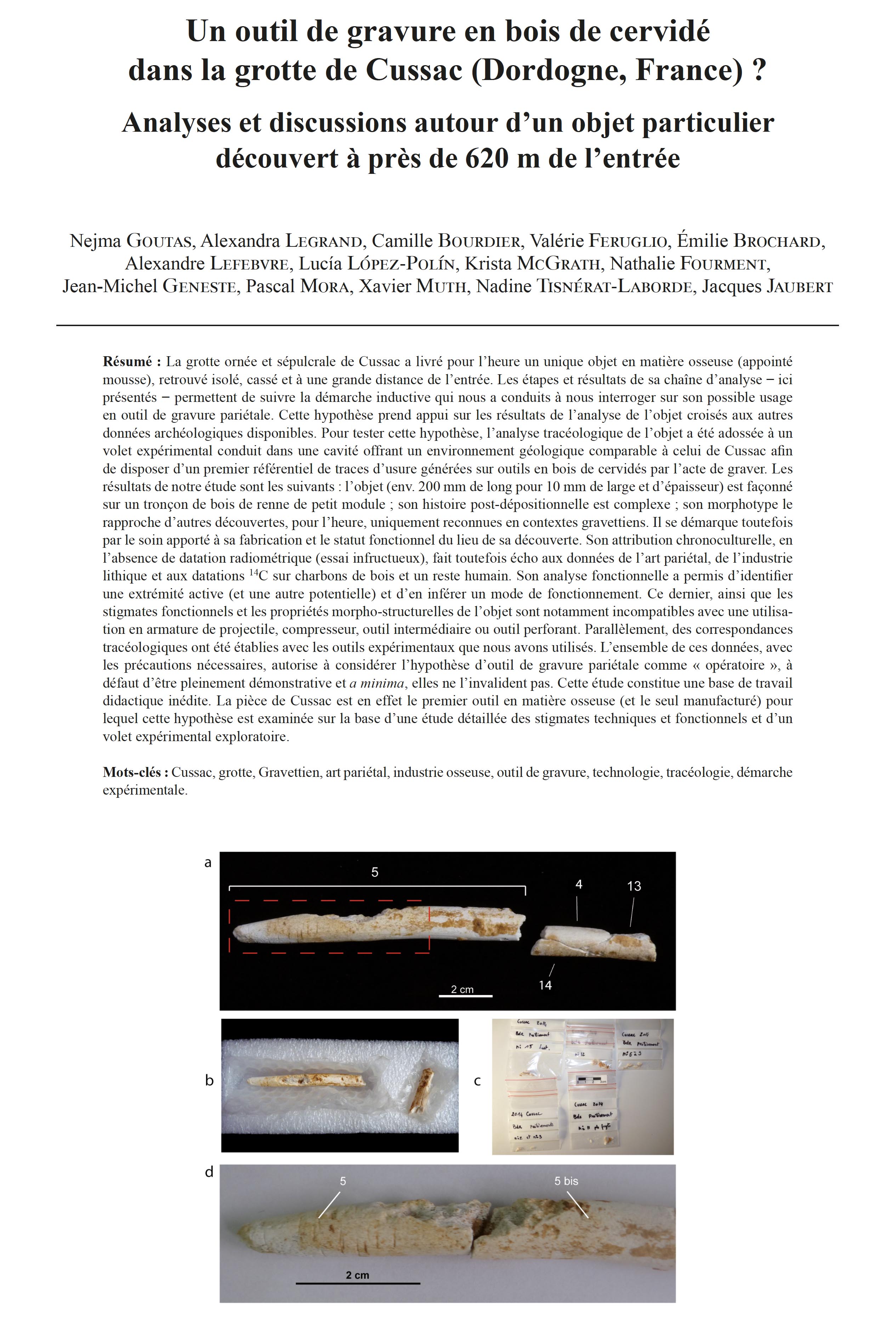
Résumé : La grotte ornée et sépulcrale de Cussac a livré pour l'heure un unique objet en matière osseuse (appointé mousse), retrouvé isolé, cassé et à une grande distance de l'entrée. Les étapes et résultats de sa chaîne d'analyse - ici présentés - permettent de suivre la démarche inductive qui nous a conduits à nous interroger sur son possible usage en outil de gravure pariétale. Cette hypothèse prend appui sur les résultats de l'analyse de l'objet croisés aux autres données archéologiques disponibles. Pour tester cette hypothèse, l'analyse tracéologique de l'objet a été adossée à un volet expérimental conduit dans une cavité offrant un environnement géologique comparable à celui de Cussac afin de disposer d'un premier référentiel de traces d'usure générées sur outils en bois de cervidés par l'acte de graver. Les résultats de notre étude sont les suivants : l'objet (env. 200 mm de long pour 10 mm de large et d'épaisseur) est façonné sur un tronçon de bois de renne de petit module ; son histoire post-dépositionnelle est complexe ; son morphotype le rapproche d'autres découvertes, pour l'heure, uniquement reconnues en contextes gravettiens. Il se démarque toutefois par le soin apporté à sa fabrication et le statut fonctionnel du lieu de sa découverte. Son attribution chronoculturelle, en l'absence de datation radiométrique (essai infructueux), fait toutefois écho aux données de l'art pariétal, de l'industrie lithique et aux datations 14C sur charbons de bois et un reste humain. Son analyse fonctionnelle a permis d'identifier une extrémité active (et une autre potentielle) et d'en inférer un mode de fonctionnement. Ce dernier, ainsi que les stigmates fonctionnels et les propriétés morpho-structurelles de l'objet sont notamment incompatibles avec une utilisation en armature de projectile, compresseur, outil intermédiaire ou outil perforant. Parallèlement, des correspondances tracéologiques ont été établies avec les outils expérimentaux que nous avons utilisés. L'ensemble de ces données, avec les précautions nécessaires, autorise à considérer l'hypothèse d'outil de gravure pariétale comme « opératoire », à défaut d'être pleinement démonstrative et a minima, elles ne l'invalident pas. Cette étude constitue une base de travail didactique inédite. La pièce de Cussac est en effet le premier outil en matière osseuse (et le seul manufacturé) pour lequel cette hypothèse est examinée sur la base d'une étude détaillée des stigmates techniques et fonctionnels et d'un volet expérimental exploratoire.
Mots-clés : Cussac, grotte, Gravettien, art pariétal, industrie osseuse, outil de gravure, technologie, tracéologie, démarche expérimentale.
Abstract: The bone industry discovered in Cussac Cave (Dordogne, France) is represented by three fragmentary, associated elements, whose structural, morphometric, and technological characteristics permit attribution to a single long, cylindrical, and pointed antler artifact. Isolated and found at a considerable distance (ca. 618 m) from the entrance of the cave, it is of significant interest both in terms of its potential chrono-cultural attribution and its presumed function. After being lost or abandoned, this object underwent various taphonomic alterations. Discovered broken, encrusted, and adhering to the floor of the cave, it raised several questions with regard to its raw material, chrono-cultural attribution, status as a processing tool as opposed to a piece of hunting equipment, its - operating mode - (according to the translation given in Guéret et al., 2014 of 'mode de fonctionnement') and its "technical function" (sensu Claud et al., 2019), and reasons for its presence in the cave. The different steps in its analysis and associated results are presented here, including in situ observations, sampling, restoration, taphonomic and techno-functional analyses, ZooMS identification, and 14C dating. They permit the reader to follow the inductive approach that guided our investigations and led us from empirical elements placed in perspective (on the object itself and its archaeological context) to explore a possible use of the Cussac object as an engraving tool in the production of parietal art. Notably, the cave contains rock art panels (e.g., the Réticulé panel in the downstream branch) with markings consistent with the use of a soft-tipped organic tool (as concluded from a 2022 published experimental study on the morphometric characterization of marks produced by different objects).
To test the plausibility of this hypothesis, the use-wear analysis of the object was complemented with an exploratory experimental component conducted in a neighboring cavity with a comparable geological environment, providing a preliminary reference for wear traces generated by engraving with antler tools (performed on weathered limestone and, to a lesser extent, on clay).
Based on this study, the following results can be reported: the object likely measured approximately 200 mm in length and 10 mm in width and thickness in its original state; it was shaped from a small-diameter reindeer antler segment (possibly a beam). Moreover, its post-depositional history is complex; its morphotype links it to other discoveries, currently recognized only in Gravettian contexts. However, it stands out due to the care of its manufacture and the status of its place of discovery in a rock art burial cave. While direct dating of the object was unsuccessful due to insufficient collagen preservation, its chrono-cultural attribution corresponds with stylistic evidence from the parietal art as well as other elements, such as radiocarbon dating of charcoal and human remains and the chronological attributions of the few lithic artifacts recovered in the cave.
The analysis identified macro- and microscopic functional marks, the nature and organization of which permit, on one hand, the identification of an active part, round-tipped and bearing short transverse incisions (and a potential second one); and, on the other hand, the inference for its operating mode. This involved a deliberate rubbing action, performed with an acute rake angle, involving brief but repeated and continuous contact of the working surface with a relatively supple but not soft material, and intermittent contact of the apex with a harder material. However, the preserved and observable wear areas do not fully represent the full extent of its original appearance due to taphonomic effects and the porous nature of bone surfaces, and must therefore be considered as a minimal approximation. It can nevertheless be noted that the object's operating mode and structural properties are incompatible with use involving high mechanical stress. At the same time, the associated nature and pattern of its use-wear traces and the non-cutting, non-piercing, non-perforating character of the object exclude its use as a hunting weapon, as an intermediary tool, an perforating tool or a pressure flaker, as well as use as a soil- or termite-excavating tool unlikely, based on reference collections used in this study. These observations allowed us to narrow down plausible functional hypotheses. At the same time, use-wear analysis correspondences were established with the experimental tools used. We thus propose, with all necessary caution, to consider it as a possible engraving tool, while remaining aware of the interpretive limits of reasoning from a single object, particularly one with a complex preservation history. This limitation is primarily circumstantial, as no other bone tools potentially associated with engraving activities have, to date, been studied from a functional perspective.
The contributions and limitations of our experimental approach are also discussed, notably the number of experimental tests conducted and the raw material used for the experimental tools. While further experiments could enrich the reference framework and improve the protocol, the results presented in this article permit - with necessary precaution - the hypothesis of a parietal engraving tool to be considered "operational," if not fully demonstrable, and at minimum, they do not invalidate it. The state of preservation of the object and its unique status that precludes comparison with other such specimens remain a limitation that cannot be overcome at present.
Our review of reported or potential cases of engraving tools in Palaeolithic cave contexts shows that the Cussac piece constitutes the first bone tool ??? and the only manufactured one ??? for which this hypothesis is discussed based on a detailed study of technical and functional attributes, combined with an experimental component. In this sense, the study provides an unprecedented didactic basis from which to address these questions. More specifically, it contributes to our understanding of and questions concerning the relationship between underground environments and material culture at Cussac Cave.
Keywords: Cussac, cave, Gravettian, parietal art, bone industry, engraving tool, technology, traceology, experimental approach.



Coordonnées
Pôle éditorial de la MSH Mondes
(Maison de l'archéologie et de l'éthnologie)
Boite 41
21 allée de l'Université
F-92023 Nanterre cedex - FRANCE